
Egypt
The sites in Egypt.
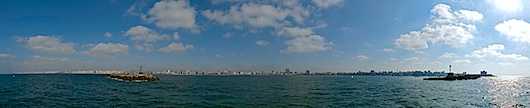
Access by sea to the eastern port of Alexandria today
Since 1992, the European Institute of Underwater Archaeology has been carrying out research in the Alexandria roadstead and the Bay of Aboukir using a scientific approach and working methods adapted to this heavily polluted area which is subject to intense natural sedimentation.
These discoveries were compared with the testimonies of the classical Greek and Latin authors and with all the previous discoveries. They allowed the establishment of a detailed cartography of the Portus Magnus of Alexandria and its surroundings, and in some cases the study of the structure of the installations and buildings that once stood near the palaces: the royal port, the Timonium, the Poseidium Peninsula, the island of Antirhodos, the ancient moles, etc. These discoveries confirm the exceptional character of the city, whose natural provisions had been used with genius to make the site a complex perfectly adapted to intense traffic.
About 30km north-east of Alexandria, the Bay of Aboukir was certainly the site on the Egyptian coastline that promised the most beautiful archaeological discoveries. As with the Eastern Port of Alexandria, the research project aimed to determine the exact ancient topography of the now submerged areas of the canopic region. The scientific approach adopted was to carry out geophysical and geological surveys, enriched by the recording of archaeological data from the excavation. The work undertaken in 1996 in the Bay of Aboukir made it possible to determine the contours of the submerged canopic region, the position of the main archaeological deposits, as well as the course of the bed of the ancient western branch of the Nile. It appeared that a vast triangle of land, 10 km high and 10 km wide, had been submerged by the waves as a result of collapse and slow subsidence. It was on this sunken area that the cities of Canope and Thônis-Héracléion, mentioned in ancient texts, once flourished.
Finally, the geophysical and geological approaches, followed by the systematically applied procedures of identification, inventory and archaeological excavation, have made possible a first global vision of the submerged canopic region and the Portus Magnus of Alexandria. The discoveries made, thanks to the work of a multidisciplinary team and an innovative approach to underwater archaeology, remain encouraging in many ways. The plans of the cities and monuments are becoming clearer every year. Of course, the major archaeological sites, located and identified, with certainty for some, by the discovery of epigraphic evidence and remarkable objects, require excavations and studies that will require decades of research. The results also raise many questions that future research will attempt to answer. In any case, they are the beginnings of future discoveries that will bring to light an entire forgotten part of the history of the Egyptian Delta.
These discoveries were compared with the testimonies of the classical Greek and Latin authors and with all the previous discoveries. They allowed the establishment of a detailed cartography of the Portus Magnus of Alexandria and its surroundings, and in some cases the study of the structure of the installations and buildings that once stood near the palaces: the royal port, the Timonium, the Poseidium Peninsula, the island of Antirhodos, the ancient moles, etc. These discoveries confirm the exceptional character of the city, whose natural provisions had been used with genius to make the site a complex perfectly adapted to intense traffic.
About 30km north-east of Alexandria, the Bay of Aboukir was certainly the site on the Egyptian coastline that promised the most beautiful archaeological discoveries. As with the Eastern Port of Alexandria, the research project aimed to determine the exact ancient topography of the now submerged areas of the canopic region. The scientific approach adopted was to carry out geophysical and geological surveys, enriched by the recording of archaeological data from the excavation. The work undertaken in 1996 in the Bay of Aboukir made it possible to determine the contours of the submerged canopic region, the position of the main archaeological deposits, as well as the course of the bed of the ancient western branch of the Nile. It appeared that a vast triangle of land, 10 km high and 10 km wide, had been submerged by the waves as a result of collapse and slow subsidence. It was on this sunken area that the cities of Canope and Thônis-Héracléion, mentioned in ancient texts, once flourished.
Finally, the geophysical and geological approaches, followed by the systematically applied procedures of identification, inventory and archaeological excavation, have made possible a first global vision of the submerged canopic region and the Portus Magnus of Alexandria. The discoveries made, thanks to the work of a multidisciplinary team and an innovative approach to underwater archaeology, remain encouraging in many ways. The plans of the cities and monuments are becoming clearer every year. Of course, the major archaeological sites, located and identified, with certainty for some, by the discovery of epigraphic evidence and remarkable objects, require excavations and studies that will require decades of research. The results also raise many questions that future research will attempt to answer. In any case, they are the beginnings of future discoveries that will bring to light an entire forgotten part of the history of the Egyptian Delta.
Alexandria

Submerged land and structures in Alexandria Harbour
In Alexandria, campaigns of topography, soundings and archaeological excavations have made it possible to develop, for the first time, a complete panorama of the famous Portus Magnus based on observations made in situ. The topography obtained is very different from what had been previously imagined from textual interpretation.
The submerged port lands and infrastructures are situated at a maximum depth of 6.5 metres. If we estimate that the ancient city once sat at a height of two metres above sea level, we can deduce that successive collapses combined with rises in sea level created a difference of over eight metres between the lands and structures and their original level. The Portus Magnus has now been mapped in its entirety. For the first time, a detailed vision of the Alexandrian port is available, as it looked during the Roman Period before the great destructions that changed the topography of the area.
The Royal Quarters began at Cape Lochias, which shut off to the east the great port where the galleys, reserved for the king’s exclusive use, were deployed. Traces of the port infrastructure remain visible on the ground because of its breakwaters and long protective wall which, according to Strabo, “hid it from men’s sight”. The island of Antirhodos, the private property of the kings, was also part of the Royal Quarters. This completely paved island was rediscovered in an entirely different location from that imagined by historians. Its central channel, 300 metres long, has an immense esplanade facing the Caesarium. The Caesarium’s entrance on the ancient coast is determined by the points where the ‘needles of Cleopatra’ stood.
On the esplanade, the remains of the foundations of a palace have been excavated. The existence of this palace was still attested by Strabo at the end of the Ptolemaic Period. These remains have been dated to the 3rd century B.C.E. The central part is strewn with numerous vestiges, including shafts of red granite columns. On a minor arm of the island, a beautiful statue of a priest of Isis (SCA 449) bearing an Osirian vase and two sphinxes were discovered. One of them (SCA 450) bears the image of King Ptolemy XII, father of Cleopatra VII. The presence of this sculpture indicates that a shrine dedicated to Isis must have been located on the island.
A small port, magnificently protected, is contained between the two arms of the island and a jetty. It is lined with quays and the great esplanade where the palace stands. Research has shown that this island had probably been developed before the founding of Alexandria and that extensive work was executed there later, towards the middle of the 3rd century B.C.E. The occupation of this island is attested after the end of the Ptolemaic Period by the artefacts found there and the presence of statue (SCA 535, 536, 537, 547) bases dating from the reigns of Septimus Severus and Caracalla.
The peninsula of the Poseidium formed an arc of land extending into the port. At its northernmost point, a strong breakwater protected the royal port of the galleys. The remains of a temple from the Roman Period have been excavated where it meets the ancient shoreline. At the end of a wall of the peninsula, extending toward the centre of a port basin, excavations have revealed foundations dating from the end of the 1st century B.C.E. and redevelopments from the period of the Antonines. The identity of the ruins is not certain, but we know, thanks to Strabo, that Marcus Antonius built the Timonium, a small palace-retreat at the end of a wall of the Poseidium. He wanted to retreat there and live in seclusion after his defeat at Actium by his rival Octavian. Could the ruins from the end of the Ptolemaic Period be those of the famous Roman general’s retreat? Excavations in progress may reveal this.
The submerged port lands and infrastructures are situated at a maximum depth of 6.5 metres. If we estimate that the ancient city once sat at a height of two metres above sea level, we can deduce that successive collapses combined with rises in sea level created a difference of over eight metres between the lands and structures and their original level. The Portus Magnus has now been mapped in its entirety. For the first time, a detailed vision of the Alexandrian port is available, as it looked during the Roman Period before the great destructions that changed the topography of the area.
The Royal Quarters began at Cape Lochias, which shut off to the east the great port where the galleys, reserved for the king’s exclusive use, were deployed. Traces of the port infrastructure remain visible on the ground because of its breakwaters and long protective wall which, according to Strabo, “hid it from men’s sight”. The island of Antirhodos, the private property of the kings, was also part of the Royal Quarters. This completely paved island was rediscovered in an entirely different location from that imagined by historians. Its central channel, 300 metres long, has an immense esplanade facing the Caesarium. The Caesarium’s entrance on the ancient coast is determined by the points where the ‘needles of Cleopatra’ stood.
On the esplanade, the remains of the foundations of a palace have been excavated. The existence of this palace was still attested by Strabo at the end of the Ptolemaic Period. These remains have been dated to the 3rd century B.C.E. The central part is strewn with numerous vestiges, including shafts of red granite columns. On a minor arm of the island, a beautiful statue of a priest of Isis (SCA 449) bearing an Osirian vase and two sphinxes were discovered. One of them (SCA 450) bears the image of King Ptolemy XII, father of Cleopatra VII. The presence of this sculpture indicates that a shrine dedicated to Isis must have been located on the island.
A small port, magnificently protected, is contained between the two arms of the island and a jetty. It is lined with quays and the great esplanade where the palace stands. Research has shown that this island had probably been developed before the founding of Alexandria and that extensive work was executed there later, towards the middle of the 3rd century B.C.E. The occupation of this island is attested after the end of the Ptolemaic Period by the artefacts found there and the presence of statue (SCA 535, 536, 537, 547) bases dating from the reigns of Septimus Severus and Caracalla.
The peninsula of the Poseidium formed an arc of land extending into the port. At its northernmost point, a strong breakwater protected the royal port of the galleys. The remains of a temple from the Roman Period have been excavated where it meets the ancient shoreline. At the end of a wall of the peninsula, extending toward the centre of a port basin, excavations have revealed foundations dating from the end of the 1st century B.C.E. and redevelopments from the period of the Antonines. The identity of the ruins is not certain, but we know, thanks to Strabo, that Marcus Antonius built the Timonium, a small palace-retreat at the end of a wall of the Poseidium. He wanted to retreat there and live in seclusion after his defeat at Actium by his rival Octavian. Could the ruins from the end of the Ptolemaic Period be those of the famous Roman general’s retreat? Excavations in progress may reveal this.

Several large port basins were developed between the cape, the peninsula, the island, the breakwater and the sea walls. Ships, even with a deep draft, could easily dock alongside the numerous quays. The ancient coast of the Royal Quarters has been discovered. This alone shows that 19th-and 20th-century reclamation work encroaching on the sea with landfills did not entirely conceal the zone that subsidence and land collapse had previously submerged. Visible along the entire eastern part of the Portus Magnus, this ancient coast is sometimes paved and contains numerous architectural remains and beautiful remnants of statuary.
To the west of the Portus Magnus, facing the Heptastadium, a port protected this long causeway of Alexander’s. Its sea walls, constructed of great limestone blocks, formed a rampart against seaborne attacks. It featured basins ideally suited to receiving ships waiting to go from the eastern port to the western port that gave access to Egyptian domestic traffic. Indeed, according to the texts, two openings were constructed in this sea wall and controlled by forts, allowing passage from one port to another. In this location there were also large shipyards that gave the name Navalia to this part of the Portus Magnus.
Two channels leading to the large port have been mapped. The main channel, towards the middle of the harbour, was bordered to the west by a large submerged rock. The narrower minor channel allowed ships to pass between this rock and the island of Pharos. The famous lighthouse must have stood nearby. Considering the topographical and geological results along with the literary evidence, and in the absence of archaeological proof showing another position, it is reasonable to hypothesize at this point that the lighthouse was located on the rock situated between the two channels.
Nothing visible remains today of this prestigious monument that was a wonder of its day. Its remains are probably hidden by the enormous mass of the current western breakwater, which links Fort Qait Bey to the great central rock, now submerged and mostly covered by the blocks of the modern structure.
The layout of the Portus Magnus now appears in all its splendour. It has proved more functional than historians had imagined. As discoveries were made, it became possible to see that first the Ptolemaic engineers, then the Romans, used the natural layout of the area extremely intelligently, and made this site a powerful port complex that could handle heavy traffic very well. With the layout of the interior ports and the numerous monuments that surrounded it, this great port, the emporium of Egypt during the Ptolemaic and Roman Periods, must certainly have looked extraordinary.
Franck Goddio, «Redicovered Sites : Alexandria » in Egypt Sunken Treasures, catalogue of the exhibition, Prestel Vlg, 2008, 2nd revised and updated edition, PP. 37-39
Thonis-Heracleion

Heracleion in the now submerged canopic region
Over six kilometres from the coast, facing the zone of East Canopus to the east, an immense concentration of ruins was discovered.
In this area, surveys uncovered the former Nile bed corresponding to the Canopic channel. Excavations made it possible to dig out a surrounding wall over 150 metres long. It probably enclosed a temple.
The discovery of the naos (SCA 0457) (monolithic chapel containing the image of the principal god venerated in this shrine) dedicated to “the Amun of the Gereb” along with information from the famous stele with the Decree of Canopus made it possible to determine the name of the city in which it stood: Heracleion. Another find confirmed the location’s identity: a gold plaque (SCA 0897) inscribed in Greek indicating that King Ptolemy III had founded (or renovated) a shrine to Herakles in this place.
A further extraordinary discovery: an intact stele (SCA 0277) of granodiorite, duplicate of the Stele of Naukratis, was recovered in this same shrine, under a wall near the naos. In traditional Egyptian, this text sanctions a decision that the founder of the 30th Dynasty, Nekhtnebef of Sebennytos (also known as Nectanebo I), made in the first year of his reign (November 378 B.C.E.), hence shortly after his accession to the throne, in favour of the temple of Neith, patron deity of Sais and protector of the preceding dynasties. Henceforth, a tithe was to be deducted from the volume of taxes regularly levied by the state, on goods and products of the Greeks of Naukratis as well as on imports that arrived by sea through the Canopic channel. The text also gave us the site’s Egyptian name: “Pharaoh orders that this be recorded on the present stele erected at the mouth of the sea of the Greeks, in the city named the Thonis of Sais.”
The simultaneous discovery of these two epigraphical documents assures the identities of the places and solves a mystery of historical geography. It sheds light on ancient texts: the Heracleion of the Greeks was none other than the Thonis of the Egyptians. The site consists of a peninsula located between several communicating port basins to the east and a lake to the west. This locality controlled access to the Canopic channel. By its geographical position, it was the principal port for trade with the Greek seas under the Pharaohs and the centre from which foreign ships were monitored. Judging by the material discovered, excavations show that this port experienced intense activity at the beginning of the city’s prosperity. The sea floor has eloquently proved this with over 700 ancient anchors of various shapes and sixteen shipwrecks dating from the 6th to the 2nd centuries B.C.E.
Boats required to pay tolls put in at the port. After a dangerous journey, sailors dedicated offerings to the gods. Remains of their gifts are scattered in large numbers on the floor of the port basins. Small votive anchors of bronze, lead or stone lie alongside cupules, miniature containers and amulets – fragile and moving proof of fulfilled vows. A more important canal linked the port basins to the Western Lake via Heracleion-Thonis. Sumptuous ritual gifts have been found, identifying the sacred character of this great waterway to the shrine. They recall the intense religious activity of this place and reflect the ceremonies of Osiris-Dionysus that took place between Heracleion and Canopus.
Significant monuments were still in the temple area. Near the naos a large basin of red granite was excavated. It was probably intended for the celebration of the mysteries of Osiris. Three colossal red granite statues over five metres high, representing a king (SCA 0279), a queen (SCA 0208) and Hapi (SCA 0281), god of fertility, abundance and the flooding of the Nile, are imposing evidence of the temple’s majesty. Beautifully crafted statues of gods and royalty, numerous bronze statuettes of divinities and ritual instruments illustrate the shrine’s cult and rituals.
An immense bilingual stele of red granite (SCA 0529), dating from the reign of Ptolemy VIII, proves that the shrine of Heracleion maintained its ideological importance under the Ptolemaic kings for Egyptians as well as for Greeks.
The paucity of objects from the Roman Period indicates that this importance did not survive after the conquerors of the Ptolemaic dynasty took control of Egypt. Was the great shrine of the Amon of the Gereb (identified with Zeus) and his son Khons (identified with Herakles) not an essential site for the celebration of dynastic continuity for these vanquished kings? The site’s occupation continued until the end of the 8th century, and the Byzantine presence, attested by the texts, is illustrated by the discovery of modest architectural elements and some jewels and coins.
With each mission the map comes closer to completion, revealing a great Egyptian emporium, active several centuries before the founding of Alexandria. The city developed around the majestic temple and was criss-crossed with a network of canals. Numerous port basins connected to the Nile received ships of all sizes at anchor. Merchandise was transported to the Western Lake, connected by a long canal to the city of Canopus. This waterway was certainly the outlet of the canal that linked Alexandria to Canopus at the time of the Ptolemaic rulers. On the islands and islets there blossomed minor shrines, esplanades supporting pavilions dominating the man-made lake, and dwellings. The city of Heracleion-Thonis, situated near the mouth of the Canopic channel linking it to Naukratis, controlled maritime traffic entering or leaving Egypt. It also served as an interface with the Canopic interior for the distribution of merchandise thanks to a network of canals that assured easy communication between its port basins, Canopus and the inland areas.
Franck Goddio, «Redicovered Sites : Alexandria » in Egypt Sunken Treasures, catalogue of the exhibition, Prestel Vlg, 2008, 2nd revised and updated edition, PP. 44-48
In this area, surveys uncovered the former Nile bed corresponding to the Canopic channel. Excavations made it possible to dig out a surrounding wall over 150 metres long. It probably enclosed a temple.
The discovery of the naos (SCA 0457) (monolithic chapel containing the image of the principal god venerated in this shrine) dedicated to “the Amun of the Gereb” along with information from the famous stele with the Decree of Canopus made it possible to determine the name of the city in which it stood: Heracleion. Another find confirmed the location’s identity: a gold plaque (SCA 0897) inscribed in Greek indicating that King Ptolemy III had founded (or renovated) a shrine to Herakles in this place.
A further extraordinary discovery: an intact stele (SCA 0277) of granodiorite, duplicate of the Stele of Naukratis, was recovered in this same shrine, under a wall near the naos. In traditional Egyptian, this text sanctions a decision that the founder of the 30th Dynasty, Nekhtnebef of Sebennytos (also known as Nectanebo I), made in the first year of his reign (November 378 B.C.E.), hence shortly after his accession to the throne, in favour of the temple of Neith, patron deity of Sais and protector of the preceding dynasties. Henceforth, a tithe was to be deducted from the volume of taxes regularly levied by the state, on goods and products of the Greeks of Naukratis as well as on imports that arrived by sea through the Canopic channel. The text also gave us the site’s Egyptian name: “Pharaoh orders that this be recorded on the present stele erected at the mouth of the sea of the Greeks, in the city named the Thonis of Sais.”
The simultaneous discovery of these two epigraphical documents assures the identities of the places and solves a mystery of historical geography. It sheds light on ancient texts: the Heracleion of the Greeks was none other than the Thonis of the Egyptians. The site consists of a peninsula located between several communicating port basins to the east and a lake to the west. This locality controlled access to the Canopic channel. By its geographical position, it was the principal port for trade with the Greek seas under the Pharaohs and the centre from which foreign ships were monitored. Judging by the material discovered, excavations show that this port experienced intense activity at the beginning of the city’s prosperity. The sea floor has eloquently proved this with over 700 ancient anchors of various shapes and sixteen shipwrecks dating from the 6th to the 2nd centuries B.C.E.
Boats required to pay tolls put in at the port. After a dangerous journey, sailors dedicated offerings to the gods. Remains of their gifts are scattered in large numbers on the floor of the port basins. Small votive anchors of bronze, lead or stone lie alongside cupules, miniature containers and amulets – fragile and moving proof of fulfilled vows. A more important canal linked the port basins to the Western Lake via Heracleion-Thonis. Sumptuous ritual gifts have been found, identifying the sacred character of this great waterway to the shrine. They recall the intense religious activity of this place and reflect the ceremonies of Osiris-Dionysus that took place between Heracleion and Canopus.
Significant monuments were still in the temple area. Near the naos a large basin of red granite was excavated. It was probably intended for the celebration of the mysteries of Osiris. Three colossal red granite statues over five metres high, representing a king (SCA 0279), a queen (SCA 0208) and Hapi (SCA 0281), god of fertility, abundance and the flooding of the Nile, are imposing evidence of the temple’s majesty. Beautifully crafted statues of gods and royalty, numerous bronze statuettes of divinities and ritual instruments illustrate the shrine’s cult and rituals.
An immense bilingual stele of red granite (SCA 0529), dating from the reign of Ptolemy VIII, proves that the shrine of Heracleion maintained its ideological importance under the Ptolemaic kings for Egyptians as well as for Greeks.
The paucity of objects from the Roman Period indicates that this importance did not survive after the conquerors of the Ptolemaic dynasty took control of Egypt. Was the great shrine of the Amon of the Gereb (identified with Zeus) and his son Khons (identified with Herakles) not an essential site for the celebration of dynastic continuity for these vanquished kings? The site’s occupation continued until the end of the 8th century, and the Byzantine presence, attested by the texts, is illustrated by the discovery of modest architectural elements and some jewels and coins.
With each mission the map comes closer to completion, revealing a great Egyptian emporium, active several centuries before the founding of Alexandria. The city developed around the majestic temple and was criss-crossed with a network of canals. Numerous port basins connected to the Nile received ships of all sizes at anchor. Merchandise was transported to the Western Lake, connected by a long canal to the city of Canopus. This waterway was certainly the outlet of the canal that linked Alexandria to Canopus at the time of the Ptolemaic rulers. On the islands and islets there blossomed minor shrines, esplanades supporting pavilions dominating the man-made lake, and dwellings. The city of Heracleion-Thonis, situated near the mouth of the Canopic channel linking it to Naukratis, controlled maritime traffic entering or leaving Egypt. It also served as an interface with the Canopic interior for the distribution of merchandise thanks to a network of canals that assured easy communication between its port basins, Canopus and the inland areas.
Franck Goddio, «Redicovered Sites : Alexandria » in Egypt Sunken Treasures, catalogue of the exhibition, Prestel Vlg, 2008, 2nd revised and updated edition, PP. 44-48
Canopus
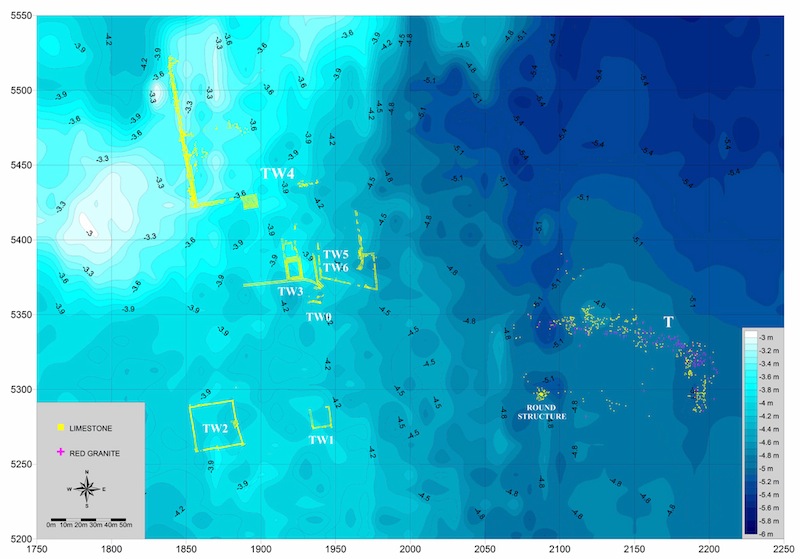
The main sites of Canope East in 2007 positioned on a bathymetric map
Research began in 1996 in the Bay of Aboukir has made it possible to determine the outline of the submerged Canopic region, the position of the principal archaeological deposits, as well as the course of the riverbed of the Nile’s former western channel.
It appears that an immense triangle of land, with a height of ten kilometres and a base of ten kilometres, was submerged by water after collapse and slow subsidence. It was on this submerged land that the cities mentioned in ancient texts prospered long ago. The analysis of these discoveries and their integration into our knowledge of ancient geography and history, as well as studies of the archaeological material, have made essential contributions to our knowledge of the Canopic region, also called Herakleotic, in reference to the existence of the great temple of Herakles near its shores.
To the east of the modern port of Aboukir researchers identified a zone containing numerous remains, including some that clearly corresponded to those discovered by Prince Toussoun in 1933. The site consists of a row of ruins 150 metres long. Broken shafts of columns of smooth red granite of various diameters are combined with limestone construction blocks and other architectural elements. Several minor constructions connect this site to a square edifice on the west with sides of thirty metres and a surviving height of almost three metres. Artefacts, including jewels, crosses, coins and seals of the Byzantine Period, contribute to identifying this complex as an immense Christian establishment. Islamic (SCA 0100, 0101) and Byzantine (SCA 0093, 0094, 0097, 0098, 0099, 0199, 0201, 0096, 0200, 0095) coins have also been discovered in various spots.
To the north of these structures, under almost two metres of sand, researchers have also dug out the well-preserved foundations of a surrounding temple wall that measures 103 metres and is constructed of large limestone blocks. The presence of these remains reveals that the largest Egyptian shrine found thus far in the region existed on this submerged site.
Between this monument and the Christian architectural complex, excavations revealed a dump where statues had been thrown, probably to be cut into pieces and used in other constructions.
Pieces of granite inscribed with hieroglyphs proved to have been part of the Naos of the Decades (SCA 0161, 0162, 0163, 0164), a famous monolithic chapel, a unique example of its kind.
Among the fragments of statuary, a remarkable marble head of the god Sarapis (SCA 0169), dating from the Ptolemaic Period, once belonged to a statue over four metres high. It was the image of the principal deity of the Sarapeum of Canopus, very well attested in ancient texts and visited by pilgrims, some of whom travelled great distances to visit its god, who was endowed with miraculous healing powers. A comparison of ancient texts, linked with certain archaeological observations, suggests that a Christian establishment built next to a great Pharaonic shrine could correspond to the foundations of the Martyry of Saint John and Saint Cyril. According to Tyrannius Rufinus, the Martyry was constructed near the Sarapeum: “Indeed, in the sepulchre of Sarapis, when the profane edifices were razed, on one side a martyry was built, on the other a church” (Ecclesiastical History, 2, 26-27).
Moreover, several observations confirm that the remains of the Egyptian temple could belong to the Sarapeum of Canopus. The distance between it and the temple of Heracleion corresponds to that mentioned in ancient texts. The size of its stone temenos shows that this monument was indeed a major shrine. The dating of objects within its area demonstrates that the monument and its vicinity were occupied during the Roman Period, and excavations show that the great temple was destroyed at the hand of man before the collapse of the Christian constructions. Its stones have almost completely disappeared, with the exception of the foundation courses. The monument apparently served as a quarry.
The establishment of the Christian complex seems therefore to have benefited from having these construction materials in the immediate vicinity. After clearly experiencing a period of prosperity in the 7th century C.E., this Christian shrine seems to have survived during the Islamic Period until the mid-8th century. These observations can be compared to texts describing the destruction of the great Serapeum of Canopus in 391 C.E. The pagan Eunapus (347–early 5th century C.E.) is very specific on this subject: “The shrines of Canopus met the same fate, when Theodosius was Emperor, when Theophilus was the leader of the damned (…). For together those people attacked our shrines with a quarryman’s enthusiasm, as if they were dealing with stones, began the assault and, without even alleging rumour of a war, destroyed the shrine devoted to Sarapis and attacked the offerings (…). Of the shrine of Sarapis only the foundation was left, because of the weight of the stones, which were not easy to move (…). Finally they introduced into these sacred places men called monks” (Life of the Philosophers, Aedesius).
Franck Goddio, «Redicovered Sites : the Submerged Canopic Region, Eastern Canopus » in Egypt Sunken Treasures, catalogue of the exhibition, Prestel Vlg, 2008,2nd revised and updated edition, PP. 40-44
It appears that an immense triangle of land, with a height of ten kilometres and a base of ten kilometres, was submerged by water after collapse and slow subsidence. It was on this submerged land that the cities mentioned in ancient texts prospered long ago. The analysis of these discoveries and their integration into our knowledge of ancient geography and history, as well as studies of the archaeological material, have made essential contributions to our knowledge of the Canopic region, also called Herakleotic, in reference to the existence of the great temple of Herakles near its shores.
To the east of the modern port of Aboukir researchers identified a zone containing numerous remains, including some that clearly corresponded to those discovered by Prince Toussoun in 1933. The site consists of a row of ruins 150 metres long. Broken shafts of columns of smooth red granite of various diameters are combined with limestone construction blocks and other architectural elements. Several minor constructions connect this site to a square edifice on the west with sides of thirty metres and a surviving height of almost three metres. Artefacts, including jewels, crosses, coins and seals of the Byzantine Period, contribute to identifying this complex as an immense Christian establishment. Islamic (SCA 0100, 0101) and Byzantine (SCA 0093, 0094, 0097, 0098, 0099, 0199, 0201, 0096, 0200, 0095) coins have also been discovered in various spots.
To the north of these structures, under almost two metres of sand, researchers have also dug out the well-preserved foundations of a surrounding temple wall that measures 103 metres and is constructed of large limestone blocks. The presence of these remains reveals that the largest Egyptian shrine found thus far in the region existed on this submerged site.
Between this monument and the Christian architectural complex, excavations revealed a dump where statues had been thrown, probably to be cut into pieces and used in other constructions.
Pieces of granite inscribed with hieroglyphs proved to have been part of the Naos of the Decades (SCA 0161, 0162, 0163, 0164), a famous monolithic chapel, a unique example of its kind.
Among the fragments of statuary, a remarkable marble head of the god Sarapis (SCA 0169), dating from the Ptolemaic Period, once belonged to a statue over four metres high. It was the image of the principal deity of the Sarapeum of Canopus, very well attested in ancient texts and visited by pilgrims, some of whom travelled great distances to visit its god, who was endowed with miraculous healing powers. A comparison of ancient texts, linked with certain archaeological observations, suggests that a Christian establishment built next to a great Pharaonic shrine could correspond to the foundations of the Martyry of Saint John and Saint Cyril. According to Tyrannius Rufinus, the Martyry was constructed near the Sarapeum: “Indeed, in the sepulchre of Sarapis, when the profane edifices were razed, on one side a martyry was built, on the other a church” (Ecclesiastical History, 2, 26-27).
Moreover, several observations confirm that the remains of the Egyptian temple could belong to the Sarapeum of Canopus. The distance between it and the temple of Heracleion corresponds to that mentioned in ancient texts. The size of its stone temenos shows that this monument was indeed a major shrine. The dating of objects within its area demonstrates that the monument and its vicinity were occupied during the Roman Period, and excavations show that the great temple was destroyed at the hand of man before the collapse of the Christian constructions. Its stones have almost completely disappeared, with the exception of the foundation courses. The monument apparently served as a quarry.
The establishment of the Christian complex seems therefore to have benefited from having these construction materials in the immediate vicinity. After clearly experiencing a period of prosperity in the 7th century C.E., this Christian shrine seems to have survived during the Islamic Period until the mid-8th century. These observations can be compared to texts describing the destruction of the great Serapeum of Canopus in 391 C.E. The pagan Eunapus (347–early 5th century C.E.) is very specific on this subject: “The shrines of Canopus met the same fate, when Theodosius was Emperor, when Theophilus was the leader of the damned (…). For together those people attacked our shrines with a quarryman’s enthusiasm, as if they were dealing with stones, began the assault and, without even alleging rumour of a war, destroyed the shrine devoted to Sarapis and attacked the offerings (…). Of the shrine of Sarapis only the foundation was left, because of the weight of the stones, which were not easy to move (…). Finally they introduced into these sacred places men called monks” (Life of the Philosophers, Aedesius).
Franck Goddio, «Redicovered Sites : the Submerged Canopic Region, Eastern Canopus » in Egypt Sunken Treasures, catalogue of the exhibition, Prestel Vlg, 2008,2nd revised and updated edition, PP. 40-44
Bonaparte’s Fleet
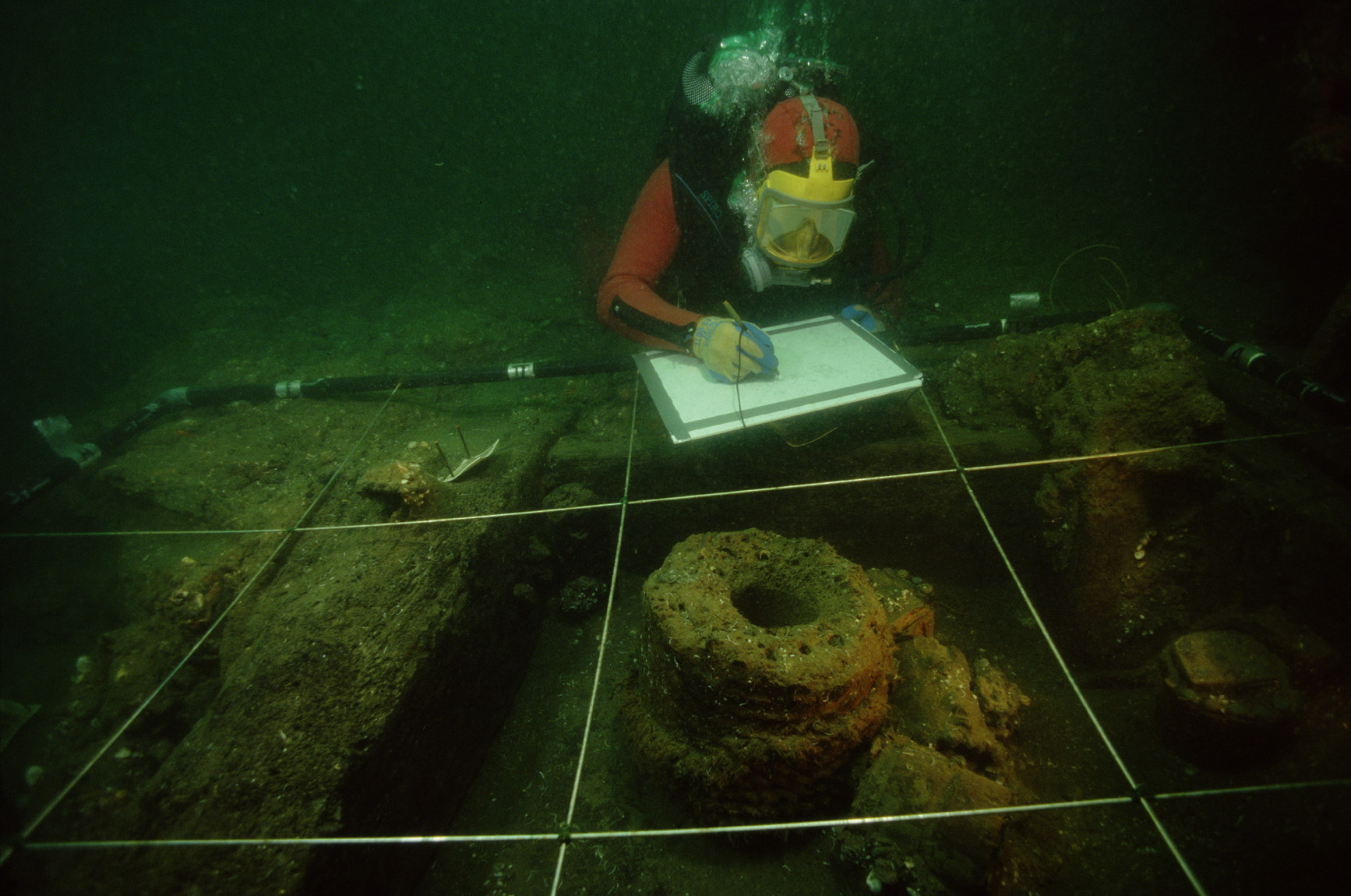
One of the pump holds of the [/Orient/]
The fleet that had carried Bonaparte and his scientists to Egypt was destroyed by Nelson during the famous battle of Aboukir in the bay north-east of Alexandria on 1 August 1798.
The wreck of the flagship of this fleet, the Orient, was discovered by Jacques Dumas in 1983. In 1998, thirteen years after the death of its initiator, the excavation of the Orient was resumed by Franck Goddio and continued for several years. In addition to the Orient, with a tonnage of more than 2700 tons and carrying 126 cannons, the frigates Artémise and Sérieuse were uncovered. The Serious, the smallest ship in the fleet, sank in a desperate attempt to block the path of the British fleet.
Seven anchors belonging to different ships were found around the Orient. They help to reconstruct the exact positions of some ships just before the tremendous explosion that destroyed the Orient.
One of the most remarkable results of the work of the IEASM, directed by Franck Goddio, is the creation of detailed maps of the seabed in the Bay of Aboukir. These maps allow us to understand the positioning of the ships during the battle and shed light on the tactics of both sides as well as the course of the battle. The arrangement of the wreckage of the Orient and its dispersion over more than half a square kilometre has led to the conclusion that the gigantic warship was not destroyed by one explosion as previously thought, but by two almost simultaneous explosions.
In addition to the cannons, weapons and ammunition, numerous everyday objects were found that provide valuable information on the daily life on board and on the crew of the ships. In addition, numerous gold, silver and copper coins from France were discovered, some dating back to the time of Louis XIV, others to the time of Louis XV, the majority to the time of Louis XVI. Even more surprising are the gold coins from Malta, the Ottoman Empire, Venice, Spain and Portugal, which suggest that they may be part of the Maltese treasure that Bonaparte, on his way to Egypt, had plundered.
Publication in progress.
The wreck of the flagship of this fleet, the Orient, was discovered by Jacques Dumas in 1983. In 1998, thirteen years after the death of its initiator, the excavation of the Orient was resumed by Franck Goddio and continued for several years. In addition to the Orient, with a tonnage of more than 2700 tons and carrying 126 cannons, the frigates Artémise and Sérieuse were uncovered. The Serious, the smallest ship in the fleet, sank in a desperate attempt to block the path of the British fleet.
Seven anchors belonging to different ships were found around the Orient. They help to reconstruct the exact positions of some ships just before the tremendous explosion that destroyed the Orient.
One of the most remarkable results of the work of the IEASM, directed by Franck Goddio, is the creation of detailed maps of the seabed in the Bay of Aboukir. These maps allow us to understand the positioning of the ships during the battle and shed light on the tactics of both sides as well as the course of the battle. The arrangement of the wreckage of the Orient and its dispersion over more than half a square kilometre has led to the conclusion that the gigantic warship was not destroyed by one explosion as previously thought, but by two almost simultaneous explosions.
In addition to the cannons, weapons and ammunition, numerous everyday objects were found that provide valuable information on the daily life on board and on the crew of the ships. In addition, numerous gold, silver and copper coins from France were discovered, some dating back to the time of Louis XIV, others to the time of Louis XV, the majority to the time of Louis XVI. Even more surprising are the gold coins from Malta, the Ottoman Empire, Venice, Spain and Portugal, which suggest that they may be part of the Maltese treasure that Bonaparte, on his way to Egypt, had plundered.
Publication in progress.


